Opens in a new tab

Operation DUNSTABLE

  • Table of Contents

MI9 (Military Intelligence) was responsible for planning the repatriation of former POW’s (Prisoners of War) after the invasion of Europe. As there was some 2.1m held in camps all over Occupied Europe (mainly Germany and Poland) and made up of eleven nationalities, the problem needed careful planning in logistics as well as medical care. According to Nichol and Rennel (2002) OPERATION VICARAGE became operational effective in March 1945 and was designed in cooperation with SOE and SHAEF to be a rapid airborne force (called Special Allied Airborne Reconnaissance Force) to protect POWs from German reprisals as the war closed.

However, this was not the only plan or strategy. A memo dated 29th November 1943 (TNA/HS4/225/109941) contemplated that if Germany suddenly collapsed, could British POWs in East of Germany be utilised to support the AK. It was evident at this stage of the war; the physical condition of POWs was not fully appreciated.

In a memo dated 29th February 1944 (TNA/HS4/229/98362 with the reference EUP/PD/5861) indicated General Sosnkowski agreed to expand the Bardsea teams in ‘order to form a cadre of groups to be dropped in Polish prison camps in Germany’. This cadre would be German speaking and whose orders were quite simple: free the prisoners and slaughter the local population. An additional 37 officers and men were to be allocated to S.T.S 63 for training and would recruit from Operation MONIKA. Approval for the operation was given on 11th April 1944. The operation was code named DUNSTABLE and like the Bardsea Operation would become entangled in politics and military strategy, for example SHAEF did not want freed Poles in N. France (often slave labour) to be removed from key industries, which might be important for the war effort.

There were growing concerns over the number of Poles who had been forcibly conscripted into the German army and TODT organization. General Kukiel representing the Polish Ministry of National Defence had since December 1943 requested SOE to consider how to encourage desertion once the invasion had started. A note of protest dated 14th June 1943 (TNA/HS4/225/1109941) by Lt. Colonel Kowaleski (Polish Special Operations Office) to Lt. Colonel R. Hazell highlighted the friction and conflict between different and often competing departments. The BBC had regularly been broadcasting insurrection messages to the Poles in the German Army and TODT Organization without the Polish Government in Exile’s permission and it was felt these messages were endangering secret cells within these organizations as well as Operation Dunstable.

Operation Dunstable was split into 3 operational areas:-

  1. Hanover – Westphalia – The Rhineland
  2. Baden – Wurtemburg
  3. Hamburg – Kiel

Each area would be split into zones and districts with instructors attached to each.

The tasks were:-

  • Organise and prepare Polish workers in Germany to defend themselves in the event of the Reich and withdrawal of troops
  • Carry out propaganda activities to maintain morale of polish workers and demoralize the German workmen.
  • Carry out intelligence activities
  • Carry out economic sabotage

In a memo dated 21st October 1944 (TNA/HS4/225/109941 referenced as PS/43/649) the troops at S.T.S designated to Dunstable and to be infiltrated into Germany in civilian clothes were as follows:

Rank, NameSkill and DesignationComments
Sgt Kurkowski, ArturW/T – Troy 5Served in German Army before attachment to S.T.S 63, Finished courses at S.T.S24a and W/T at S.T.S 63
Cpl. Skopowski, JanTroy 17Served in German Army before attachment to S.T.S 63, Finished courses at S.T.S24a and W/T at S.T.S 63
L/Cpl. Ilkow, StanislawW/T – Troy 29Escaped from Poland via Switzerland and France. Was in German concentration camp before posting to S.T.S63. , Finished courses at S.T.S24a and W/T at S.T.S 63. Does not speak German well. Volunteered.
L/Cpl. Roszyk, AlojzyW/T – Troy 24Served in German Army before attachment to S.T.S 63, Finished courses at S.T.S24a and W/T at S.T.S 63
L/Cpl. Baranski, FrederykTroy 20Came from France, speaks little German, but volunteered for work. Served in German Army before attachment to S.T.S 63, Finished courses at S.T.S24a and W/T at S.T.S 63
L/Cpl. Wrog, FranciszekHector 16Served in German Army in Normandy. Finished courses in W/T at S.T.S 63
L/Cpl. Ogrodowski, FranciszekTroy 23Served in German Army before attachment to S.T.S 63, Finished courses at S.T.S24a and W/T at S.T.S 63
Pt. Borowski, Marian(?)Served in German Army before attachment to S.T.S 63, Finished courses at S.T.S24a and W/T at S.T.S 63
Cpl. Kupc, FranciszekAlpha 10Ex-Bardsea, Comes from France. , Finished courses at S.T.S24a and W/T at S.T.S 63. Speaks little German
Cpl. Ortyl, JanGamma 11Ex-Bardsea, , Finished courses at S.T.S24a and S.T.S 63. W/T completed at S.T.S 53. Does not speak German.

Records show both the Dunstable and Bardsea troops trained together and that under the direction of Major Kowalski completed a special training exercise in Brighton from 2-4th October 1944. The exact nature of the exercise is not disclosed. However, Colonel Hazell had suggested another 100 men were needed for this operation and any Bardsea teams not employed could be transferred despite S.T.S 63 having inadequate space to accommodate this number of personnel after some had been posted for training in Group B School.

The Dunstable training schedule looked like the details set out below.

January 1945

Date/ Section08.309.3010.3011.30Lunch
12.30
14.0015.0016.00
03.01.45
I
II
III
Field Craft
(Gen. Lecture)
Musketry
Demolition
PT
Weapons
Musketry
Demolition
Weapons
Weapons
Musketry
Demolition
PT
Weapons
Weapons
Weapons
Musketry
Drill
Whole
Company
04.01.45
I
II
III
Map Reading
Demolition
Silent Killing
Map Reading
PT
Musketry
W/T Ops
Map Reading
Demolition
W/T Ops
Map Reading
PT
Weapons
W/T Ops
Map Reading
Drill
W/T Ops
Map Reading
Army
Regulations
05.01.45
I
II
III
Silent Killing
Weapons
W/T Ops
Musketry
Drill
W/T Ops
Demolition
Silent Killing
Weapons
PT
Musketry
Drill
Field Craft Whole
Company
Field Craft Whole
Company
Field Craft Whole
Company
06.01.45
I
II
III
MassMassMassLectureFree  
07.01.45
I
II
III
MassMassMass  Free  
08.01.45
I
II
III
Field Craft
Musketry
PT
Map Reading
Field Craft
Musketry
Musketry
PT
Field Craft
PT
Map Reading
Map Reading
W/T Ops
W/T Ops
W/T Ops
W/T Ops
W/T Ops
W/T Ops
Drill
Whole
Company
09.01.45
I
II
III
Musketry
Field Craft
Silent Killing
Map Reading
Field Craft
PT
Silent Killing
Musketry
Field Craft
PT
Map Reading
Field Craft
Field Craft
Silent Killing
Musketry
Field Craft
PT
Map Reading
German
Whole
Company
10.01.45
I
II
III
Demolition
Weapons
Field Craft
Demolition
Musketry
Field Craft
Field Craft
Demolition
Weapons
Field Craft
Demolition
Musketry
Weapons
Field Craft
Demolition
Musketry
Field Craft
Demolition
Army
Regulations
11.01.45
I
II
III
Map Reading
Weapons
Musketry
PT
Parachute Tng
Silent Killing
Silent Killing
Map Reading
Weapons
Musketry
PT
Parachute Tng
Demolition
Silent Killing
Demolition
Weapons
Musketry
PT
Parachute Tng
Demolition
Demolition
12.01.45
I
II
III
Field Craft
W/T Ops
Musketry
Field Craft
W/T Ops
Parachute Tng
W/T Ops
Field Craft
W/T Ops
W/T Ops
Field Craft
W/T Ops
Musketry
PT
Field Craft
Parachute Tng
Musketry
Field Craft
PT
Parachute Tng
PT
13.01.45
I
II
III
Drill
Whole
Company
German
Lecture
CO’s
Lecture
Kit
Inspection
Weapon
Cleaning
Barrack
Cleaning/
Inspection
 
14.01.45
I
II
III
MassMassCO’s
Hour
 Free  

Source: TNA/HS4/225/109941

The training schedule was completed on 4th February 1945and signed off by Company Commander Captain Stepien. Their training included night exercises using 2 or 3 three ton trucks and medical lecturers to assist their survival chances in the field.

A letter dated 22nd December 1944 from Lt. Colonel Dasher (US MI) to Colonel J. Lunkiewicz indicates Dunstable teams were in the field in the US Zone in Europe and based in Dinant. While the contents cover logistical issues, the US clearly admired the quality and well organized operation, which would not be interfered with by the Supreme HQ. However, by February 1945 progress in Europe meant the full company may not be effectively ready to complete their original task. It was suggested the company would be split into 6 sections headed by an officer with one W/T operator attached to the section. Their tasks would be reallocated to include small commando raids deep into enemy territory (deeper than S.P.U 22) or selected Polish POW camps. Here they would protect the prisoners until the allies reached them.

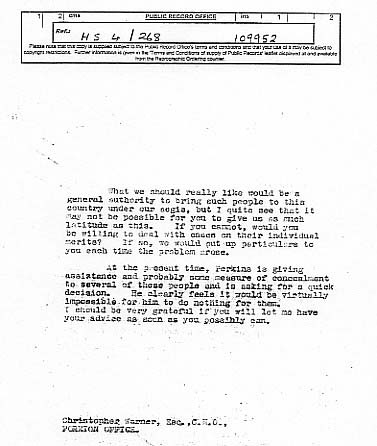
Records of the Dunstable Operation become sketchy and inconsistent in terms of revealing activity. In the archives a report by Christopher Warner, C.M.G of the Foreign Office dated 1st August 1945 (TNA/HS4/268/109952) reveals the impending problems caused by the collapse of the Third Reich.
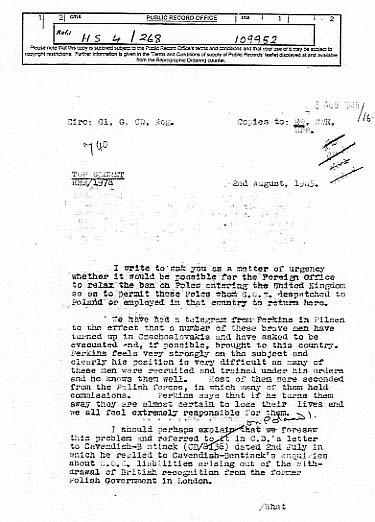
A typewritten letter dated 2 August 1945, marked "TOP SECRET", discusses the employment of German rocket experts in Allied countries after the Second World War.
A typewritten letter referencing difficulties bringing people to the UK and the need for a quick decision, with an official heading and signature at the bottom.

The report indicated eighty-six stranded agents needed repatriation to the UK. The size of the problem becomes clear simply through their geographic spread. Many of the agents had been in prison or in concentration camps and although twenty-two had already made it back to the UK, there were logistical problems. Eight were in Brussels and three in Paris, leaving around fifty in the ‘system’, but had not reported themselves to the authorities. In addition, the Polish VIth Bureau wanted the Paris based agents returned quickly so that they could close down the post. Concerns were raised about the number of agents in various parts of Europe ‘turning up’. Colonel Perkins was embarrassed by being left with six agents held up at Pilsen who were a Polish Ministry of Interior agent (sent to Poland in 1943) accompanied by his wife, two Polish Consular officials and one wife, and Mme Razska wife of Air Commodore Razska who was the Polish Air Force liaison officer assisting operations in Italy.

It appears from correspondence; Mme Razska’s ability to enter the UK would be turned down until the British Government had made a ruling on the resettlement of Poles irrespective of the courage or dangers they had shown while in service.

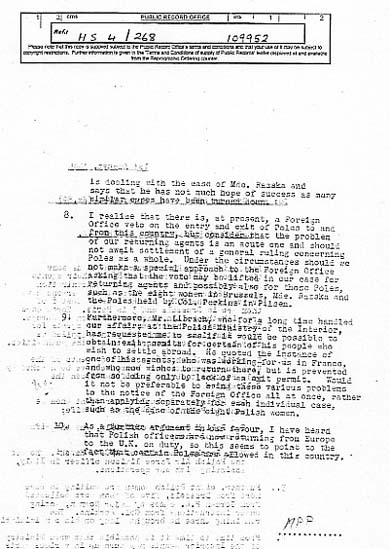
A scanned, typewritten declassified military document dated 1 August 1944, detailing a report on Polish Home Forces operations, with handwritten annotations.
A typewritten, declassified government document with black redactions and visible reference numbers at the top. The text discusses a foreign officer’s situation.

Jan Librach who had been instrumental in the setting up of operations in France was having difficulty in obtaining permits for former agents to be resettled abroad, particularly France where eight female agents were barred from returning.

The resettlement issue and the withdrawal in recognition of the Polish Government in London was one of the low points of Anglo-Polish politics and today remains embarrassing – a hurt that will not easily purged. A response to Warner’s report clearly revealed the British duplicity. More agents attached to SOE had arrived in Pilsen causing further embarrassment to Col. Perkins. The absurdity of the British Government was revealed in the following story revealed in a Top Secret cipher.

A cipher dated 03.08.45 from ‘Chequebook’ (TNA/HS4/268/109952) reveals the fate of an agent Peter Czes.
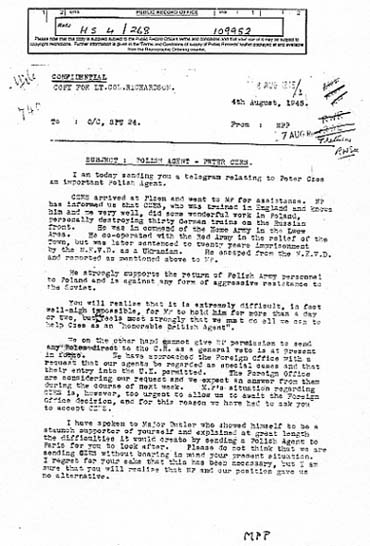
Black and white scan of a confidential typed letter dated 4 August 1949, discussing Polish Army personnel and resistance activities; includes handwritten notes and markings.
A typewritten declassified military document dated 1945, labelled “Public Record Office”, with handwritten notes and annotations throughout the page.

Sent to Poland in Operation CAPE he personally destroyed 30 German trains on the Russian front and was in command of the AK in the Lwow and cooperated with the Soviet Army’s relief of the city. Caught by the Soviets, Czes was sentenced to 20 years imprisonment as a Ukrainian by the NKVD. Peter Czes escaped and supported the return to Poland of former service personnel, but was against any ‘aggressive resistance’ to the Soviet occupation of Poland. The cipher clearly points out the need to allow repatriation in order ‘not to lose every vestige of respect in Central Europe.’

To avoid further issue, the cipher revealed Peter Czes would be sent to Paris or Brussels in the guise as a former POW to circumvent the blockade or veto on returning agents. A subsequent cipher made the order for Peter Czes to report to 62 Rue du Faubourg, St. Honore in Paris. However, this was not before numerous interdepartmental memos either upholding the veto or trying to renegotiate conditions for return. The spill-over included the Foreign Office and the OSS as Pilsen was under US control with the final word being left to the Home Office. The situation became increasingly desperate and placed these agents in real danger. A cipher dated 11.08.45 indicated the 2nd Parachute Regiment could be used to force the displaced agents and Polish service personnel in Pilsen across the border into Poland. Luckily, there was only one officer and a W/T operator spare and the OSS were over stretched. The order was never carried out. How fast the tables had turned !

On 21st August 1945 the Anglo-Polish Liquidation Committee and the Polish Armed Forces Committee were set up to settle all matters relating to the Polish Government in Exile. A key task of both committees was to sort out those who still required repatriation or had decided to emigrate. Count Raczynski would act as liaison between the British and Polish governments. While orders were issued to return agents to Britain, individual cases still caused concern. A cipher dated 22nd August indicated only one agent SAMOTUS and his wife were being held in Pilsen. All others were heading west via Bavaria for Britain with the debate about visas still raging between different departments.
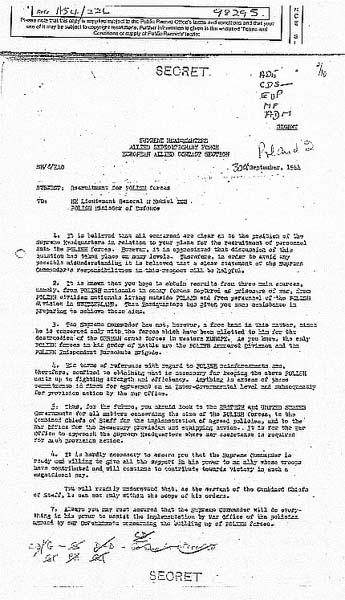
Declassified Second World War-era document marked "SECRET," typed on official letterhead, containing military correspondence and signatures.
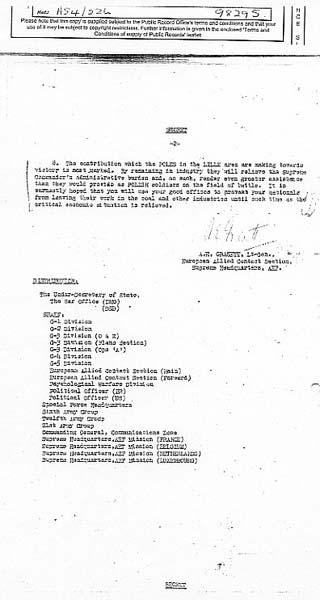
A declassified typewritten memorandum listing contributions by the PLO in Lebanon and a distribution list, marked confidential and addressed to the US State Department.

A cable from the British Ambassador in Moscow (TNA/HS4/268/109952) revealed the delicate case of a Polish officer who had been caught by the NKVD. Known as Captain Alun Morgan, the Embassy lobbied for his release and succeeded in getting him back to Britain on the Ambassadors special flight. However, the archive reveals there may have been others held with requests to clarify the names of those held made to V. Yerofeev of the People’s Commissariat for foreign Affairs in Moscow.

The resettlement period was not without complication for returning agents. The debriefing and return to ‘normal’ duties at times must have appeared petty in light of the war almost over without considering the personal risk and sacrifices made. Many agents had taken their salaries into the field – for what purposes we will never know, but most likely to be passed on to family. In the field the ground commanders often ‘confiscated’ the money to help pay for the unit. On return to Britain, many agents were destitute.

A letter dated 25th October 1945 (TNA/ HS4/268/109952) from a British officer (no name) on leave in Penrhyndeudraeth, North Wales highlights the difficulties the agents faced.
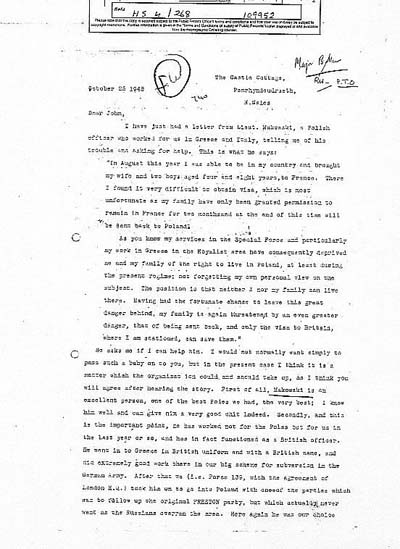
A typewritten letter dated 25 October 1943 discusses wartime experiences and observations, with handwritten notes and stamps visible at the top of the page.
A typewritten letter with a bureaucratic heading, sections of text, and a handwritten note at the bottom, addressing official obligations and appreciation.

Lieut. Makowski had trained and then served in the Polish Special Forces (Drogi Cichociemnych). Dressed in British uniform with false papers, he had worked behind the lines in Italy and Greece with Force 139. His duties in Greece were to destabilise the stretched German Army and had been based with the Greek Royalists. Pulled out of Greece, Lieut. Makowski was designated to follow up the FRESTON operation in southern Poland, but the Soviet Army had over-ran the area and the operation was cancelled. Having fought with the Greek Loyalists, Makowski and his family would on return to Poland face life sentences in Siberia. The author of the letter confesses to finding it difficult to pin bravery awards on one hand and with the other give a death sentence. The letter begs the recipient to contact a Major George Klauber to verify the case. Lieut. Makowski lived at 10 St. Leonards Road, London W.13 and a pencilled note indicates he was allowed to stay in Britain.
Tarrant Rushton Airfield
http://www.tarrant-rushton.ndirect.co.uk
or email: andrew.wright5@virgin.net

Women of the SOE
http://www.64-baker-street.org

The Warsaw Rising
https://www.polandinexile.com/rising.htm

The Polish Air Force – Pictures with Questions
http://polishwings.bravepages.com

La traduction française de cet article n'est pas encore disponible.

MI9 (wywiad wojskowy) odpowiadał za planowanie repatriacji byłych jeńców wojennych po inwazji na Europę. Biorąc pod uwagę, że w obozach na terenie okupowanej Europy (głównie w Niemczech i Polsce) przebywało około 2,1 miliona jeńców reprezentujących jedenaście narodowości, kwestia ta wymagała starannego planowania zarówno pod względem logistycznym, jak i medycznym. Według Nichola i Rennela (2002) operacja „Vicarage” weszła w fazę realizacji w marcu 1945 roku; została ona opracowana we współpracy z SOE i SHAEF jako szybka formacja powietrznodesantowa (pod nazwą Special Allied Airborne Reconnaissance Force – Specjalne Alianckie Powietrznodesantowe Siły Rozpoznawcze), której zadaniem była ochrona jeńców przed niemieckimi represjami w końcowej fazie wojny.

Nie był to jednak jedyny plan czy strategia. W notatce z 29 listopada 1943 roku (TNA/HS4/225/109941) rozważano możliwość wykorzystania brytyjskich jeńców przebywających we wschodnich Niemczech do wsparcia Armii Krajowej w przypadku nagłego załamania się Niemiec. Na tym etapie wojny nie doceniano jednak w pełni stanu fizycznego jeńców.

Notatka z 29 lutego 1944 roku (TNA/HS4/229/98362, sygnatura EUP/PD/5861) wskazywała, że ​​generał Sosnkowski wyraził zgodę na rozszerzenie składu zespołów „Bardsea” w celu „utworzenia kadry grup przeznaczonych do zrzutu w pobliżu polskich obozów jenieckich w Niemczech”. Członkowie tej kadry mieli posługiwać się językiem niemieckim, a ich rozkazy były proste: uwolnić więźniów i dokonać masakry miejscowej ludności. Do ośrodka szkoleniowego S.T.S. 63 skierowano dodatkowo 37 oficerów i szeregowych, rekrutowanych spośród uczestników operacji „Monika”. Zgodę na przeprowadzenie operacji wydano 11 kwietnia 1944 roku. Operacja otrzymała kryptonim „Dunstable” i – podobnie jak operacja „Bardsea” – została uwikłana w kwestie polityczne oraz strategię wojskową; na przykład dowództwo SHAEF nie chciało, aby uwolnieni Polacy przebywający w północnej Francji (często wykorzystywani jako przymusowa siła robocza) byli wycofywani z kluczowych gałęzi przemysłu, istotnych dla wysiłku wojennego.

Rosło również zaniepokojenie liczbą Polaków przymusowo wcielonych do armii niemieckiej oraz Organizacji Todta. Generał Kukiel, reprezentujący polskie Ministerstwo Obrony Narodowej, od grudnia 1943 roku zwracał się do SOE z wnioskiem o rozważenie sposobów zachęcania do dezercji po rozpoczęciu inwazji. Nota protestacyjna z 14 czerwca 1943 roku (TNA/HS4/225/1109941), skierowana przez podpułkownika Kowaleskiego (z polskiego Biura Operacji Specjalnych) do podpułkownika R. Hazella, wskazywała na napięcia i konflikty między różnymi, często konkurującymi ze sobą komórkami. BBC regularnie nadawało komunikaty wzywające do powstania, adresowane do Polaków służących w armii niemieckiej oraz Organizacji Todta, czyniąc to bez zgody polskiego rządu na uchodźstwie; uważano, że audycje te narażały na niebezpieczeństwo tajne komórki działające w ramach tych organizacji, a także zagrażały powodzeniu operacji „Dunstable”.

Operację „Dunstable” podzielono na trzy obszary operacyjne:
Hanower – Westfalia – Nadrenia

Badenia – Wirtembergia

Hamburg – Kilonia

Każdy z tych obszarów miał zostać podzielony na strefy i okręgi, do których przydzielono by instruktorów.

Do zadań należało:

organizowanie i przygotowywanie polskich robotników w Niemczech do samoobrony na wypadek upadku Rzeszy i wycofania się wojsk;

prowadzenie działań propagandowych mających na celu utrzymanie morale polskich robotników oraz demoralizację niemieckich pracowników;

prowadzenie działań wywiadowczych;

dokonywanie aktów sabotażu gospodarczego.

W notatce z dnia 21 października 1944 r. (sygn. TNA/HS4/225/109941, nr ref. PS/43/649) wyszczególniono następujące grupy żołnierzy ze stacji S.T.S. w Dunstable, wyznaczonych do przerzutu do Niemiec w cywilnych ubraniach:

Z dokumentacji wynika, że ​​oddziały z Dunstable i Bardsea szkoliły się wspólnie i pod dowództwem majora Kowalskiego odbyły specjalne ćwiczenia w Brighton w dniach 2–4 października 1944 roku. Dokładny charakter tych ćwiczeń nie został ujawniony. Pułkownik Hazell sugerował jednak, że do operacji potrzeba kolejnych 100 ludzi i że można by tam skierować niewykorzystane dotąd zespoły z Bardsea – mimo iż ośrodek S.T.S. 63 nie dysponował wystarczającą przestrzenią, by pomieścić taką liczbę personelu po tym, jak część żołnierzy oddelegowano na szkolenie w szkole Grupy B.

Program szkolenia zakończono 4 lutego 1945 roku i zatwierdzono podpisem dowódcy kompanii, kapitana Stępnia. Szkolenie obejmowało ćwiczenia nocne z wykorzystaniem dwóch lub trzech ciężarówek trzytonowych oraz wykłady medyczne, mające na celu zwiększenie szans żołnierzy na przetrwanie w warunkach polowych.

Pismo z 22 grudnia 1944 roku, skierowane przez podpułkownika Dashera (z amerykańskiego wywiadu wojskowego – US MI) do pułkownika J. Lunkiewicza, wskazuje, że zespoły „Dunstable” działały w terenie w amerykańskiej strefie okupacyjnej w Europie, a ich baza znajdowała się w Dinant. Choć korespondencja dotyczyła kwestii logistycznych, strona amerykańska wyraźnie doceniała jakość i doskonałą organizację operacji, w której przebieg Naczelne Dowództwo nie zamierzało ingerować. Jednakże w lutym 1945 roku sytuacja na froncie europejskim sprawiła, że ​​cała kompania mogła nie być w pełni gotowa do realizacji pierwotnego zadania. Zaproponowano podział kompanii na sześć sekcji dowodzonych przez oficerów, z których każda miała zostać wzmocniona operatorem radiostacji. Zakres ich zadań miał zostać zmodyfikowany tak, aby obejmował niewielkie rajdy komandosów głęboko na tyłach wroga (dalej niż w przypadku działań jednostki S.P.U. 22) lub akcje w wybranych obozach jenieckich dla Polaków. W takich miejscach żołnierze mieli chronić jeńców do czasu nadejścia sił alianckich.

Dokumentacja dotycząca operacji „Dunstable” w zakresie opisu prowadzonych działań jest niepełna i niespójna. W archiwach znajduje się raport Christophera Warnera (C.M.G.) z brytyjskiego Ministerstwa Spraw Zagranicznych (Foreign Office), datowany na 1 sierpnia 1945 roku (sygn. TNA/HS4/268/109952), który ukazuje nadchodzące problemy wynikające z upadku III Rzeszy.

Z raportu wynikało, że osiemdziesięciu sześciu agentów utknęło za granicą i wymagało repatriacji do Wielkiej Brytanii. Skala problemu stawała się oczywista już choćby ze względu na ich rozproszenie geograficzne. Wielu z tych agentów przeszło przez więzienia lub obozy koncentracyjne; mimo że dwudziestu dwóch zdołało już wrócić do Wielkiej Brytanii, istniały trudności logistyczne. Ośmiu przebywało w Brukseli, a trzech w Paryżu, podczas gdy około pięćdziesięciu pozostawało w „systemie”, nie zgłaszając się jednak do władz. Ponadto polski VI Oddział nalegał na szybki powrót agentów z Paryża, aby móc zlikwidować tamtejszą placówkę. Obawy budziła również rosnąca liczba agentów „pojawiających się” w różnych zakątkach Europy. Kłopotliwą sytuację dla pułkownika Perkinsa stanowiło sześciu agentów zatrzymanych w Pilźnie: funkcjonariusz polskiego MSW (wysłany do kraju w 1943 roku) wraz z żoną, dwaj polscy urzędnicy konsularni (jeden z nich z żoną) oraz pani Razska – małżonka komandora lotnictwa Razski, oficera łącznikowego polskich sił powietrznych wspierającego działania we Włoszech.

Z korespondencji wynikało, że zgoda na wjazd pani Razski do Wielkiej Brytanii nie zostanie wydana, dopóki rząd brytyjski nie podejmie decyzji w sprawie przesiedlenia Polaków – niezależnie od odwagi, jaką wykazali się oni w służbie, czy niebezpieczeństw, na jakie byli narażeni.

Jan Librach, który odegrał kluczową rolę w organizacji działań we Francji, napotykał trudności w uzyskaniu zezwoleń na przesiedlenie byłych agentów za granicę – zwłaszcza do Francji, gdzie ośmiu agentkom odmówiono prawa powrotu.

Kwestia przesiedleń oraz wycofanie uznania dla polskiego rządu w Londynie stanowiły jeden z najtrudniejszych momentów w relacjach brytyjsko-polskich i do dziś pozostają źródłem zażenowania – bolesną sprawą, o której niełatwo zapomnieć. Reakcja na raport Warnera wyraźnie obnażyła brytyjską dwulicowość. Do Pilzna przybyli kolejni agenci współpracujący z SOE, co wprawiło pułkownika Perkinsa w jeszcze większe zakłopotanie. Absurdalną postawę brytyjskiego rządu ukazuje historia opisana w depeszy szyfrowej o klauzuli „ściśle tajne”.

Depesza z 3 sierpnia 1945 roku, nadana pod kryptonimem „Chequebook” (sygn. TNA/HS4/268/109952), ujawnia losy agenta Petera Czesa.

Wysłany do Polski w ramach operacji CAPE, osobiście zniszczył 30 niemieckich pociągów na froncie rosyjskim i dowodził AK we Lwowie, współpracując z Armią Radziecką w odsieczy miasta. Złapany przez Sowietów, Czes został skazany przez NKWD na 20 lat więzienia jako Ukrainiec. Peter Czes uciekł i wspierał powrót do Polski byłych żołnierzy, ale sprzeciwiał się jakiemukolwiek „agresywnemu oporowi” wobec sowieckiej okupacji Polski. Szyfr wyraźnie wskazuje na potrzebę umożliwienia repatriacji, aby „nie stracić żadnego śladu szacunku w Europie Środkowej”.

Aby uniknąć dalszych problemów, szyfr ujawnił, że Peter Czes zostanie wysłany do Paryża lub Brukseli pod przykrywką byłego jeńca wojennego, aby obejść blokadę lub weto wobec powracających agentów. Kolejny szyfr nakazywał Peterowi Czesowi stawienie się pod adresem 62 Rue du Faubourg, St. Honore w Paryżu. Jednak nie nastąpiło to przed licznymi notatkami międzyresortowymi, podtrzymującymi weto lub próbującymi renegocjować warunki powrotu. Skutki uboczne obejmowały Ministerstwo Spraw Zagranicznych i Biuro Służby Bezpieczeństwa (OSS), ponieważ Pilzno znajdowało się pod kontrolą USA, a ostateczna decyzja należała do Ministerstwa Spraw Wewnętrznych. Sytuacja stawała się coraz bardziej rozpaczliwa i narażała agentów na realne niebezpieczeństwo. Szyfr z datą 11.08.1945 wskazywał, że 2. Pułk Spadochronowy mógł zostać użyty do wymuszenia na przesiedlonych agentach i polskim personelu wojskowego z Pilzna przejścia przez granicę do Polski. Na szczęście był tylko jeden oficer i jeden rezerwowy operator W/T, a Biuro Służby Bezpieczeństwa było przeciążone. Rozkaz nigdy nie został wykonany. Jak szybko sytuacja się odwróciła!

21 sierpnia 1945 roku powołano Anglo-Polską Komisję Likwidacyjną i Komisję ds. Polskich Sił Zbrojnych, aby rozstrzygnąć wszystkie sprawy dotyczące Rządu Polskiego na Uchodźstwie. Kluczowym zadaniem obu komisji było uporządkowanie spraw osób, które nadal wymagały repatriacji lub zdecydowały się na emigrację. Hrabia Raczyński miał pełnić funkcję łącznika między rządami brytyjskim i polskim. Chociaż wydano rozkazy odesłania agentów do Wielkiej Brytanii, pojedyncze przypadki nadal budziły niepokój. Szyfr z datą 22 sierpnia wskazywał, że w Pilźnie przetrzymywany jest tylko jeden agent, SAMOTUS, i jego żona. Wszyscy pozostali zmierzali na zachód przez Bawarię do Wielkiej Brytanii, gdzie toczyła się debata na temat w sprawie wiz, która wciąż rozgorzewa między różnymi departamentami.

Depesza od ambasadora Wielkiej Brytanii w Moskwie (TNA/HS4/268/109952) ujawniła delikatną sprawę polskiego oficera schwytanego przez NKWD. Ambasada zabiegała o uwolnienie mężczyzny, znanego jako kapitan Alun Morgan, i doprowadziła do jego powrotu do Wielkiej Brytanii specjalnym lotem ambasadora. Z materiałów archiwalnych wynika jednak, że przetrzymywano prawdopodobnie także inne osoby; w związku z tym zwrócono się do W. Jerofiejewa z Ludowego Komisariatu Spraw Zagranicznych w Moskwie z prośbą o ustalenie tożsamości zatrzymanych.

Okres powrotu do normalnego życia wiązał się dla agentów z pewnymi komplikacjami. Procedury końcowe i powrót do rutynowych obowiązków mogły niekiedy wydawać się błahe w obliczu dobiegającej końca wojny – zwłaszcza gdy pominąć kwestię osobistego ryzyka i poniesionych ofiar. Wielu agentów zabierało ze sobą na misję żołd; nie wiemy, w jakim celu – choć najpewniej po to, by przekazać go rodzinie. W terenie dowódcy polowi często „rekwirowali” te pieniądze na potrzeby utrzymania oddziału. Po powrocie do Wielkiej Brytanii wielu agentów pozostawało bez środków do życia.

Trudności, z jakimi mierzyli się agenci, dobrze obrazuje list z 25 października 1945 roku (sygn. TNA/ HS4/268/109952), napisany przez brytyjskiego oficera (którego nazwiska nie podano), przebywającego na urlopie w Penrhyndeudraeth w północnej Walii.

Porucznik Makowski przeszedł szkolenie, a następnie służył w polskich siłach specjalnych (w szeregach „Cichociemnych”). W brytyjskim mundurze i posługując się fałszywymi dokumentami, działał na tyłach wroga we Włoszech i Grecji w ramach Force 139. Jego zadaniem w Grecji było destabilizowanie rozciągniętych linii niemieckich sił zbrojnych; współpracował przy tym z greckimi rojalistami. Po wycofaniu z Grecji porucznik Makowski został wyznaczony do udziału w kontynuacji operacji „Freston” w południowej Polsce, jednak obszar ten został zajęty przez Armię Czerwoną, co spowodowało odwołanie operacji. Za walkę u boku greckich lojalistów Makowskiemu i jego rodzinie – po powrocie do Polski – groziło dożywocie na Syberii. Autor listu przyznaje, że trudno mu z jednej strony przyznawać odznaczenia za męstwo, a z drugiej – wydawać wyroki śmierci. W liście zawarto prośbę do adresata o skontaktowanie się z majorem George’em Klauberem w celu zweryfikowania sprawy. Porucznik Makowski mieszkał przy St. Leonards Road 10 w Londynie (dzielnica W13), a odręczna notatka ołówkiem wskazuje, że pozwolono mu pozostać w Wielkiej Brytanii.

Two tanks and a damaged car sit on a debris-strewn street in a city with ruined buildings, whilst people walk and cycle nearby amid a hazy atmosphere.

The London-Budapest Game.

Catherine E. Schandl, 2007 by Lulu Books Inc, USA (On-line self-publishing site) ISBN 978-1-4303-1178-2 The London-Budapest Game is part of a trilogy (“Sword of the Turul” and “Swedish Gold”) tracing the life and activities of Karoly Schandl, an idealistic lawyer in Budapest during the Nazi occupation.  It is an interesting read since it covers not just the…

Read Article
Black and white portrait of a man in a military uniform and cap, facing slightly to the side.

Mieczyslaw M. Wnuk

From Olympic skier to wartime escapee and commando trainer — the epic journey of Polish officer Mieczyslaw Wnuk from Zakopane to Dunblane, Scotland.

Read Article
T-Force: The Forgotten Heroes of 1945

T-Force: The Forgotten Heroes of 1945

Sean Longden’s T-Force uncovers the secret Allied unit that seized Nazi technology in 1945—missions that shaped the Cold War and inspired Ian Fleming’s James Bond.

Read Article