Opens in a new tab

Special Planning Unit 22

  • Table of Contents

(a.k.a Special Forces Mission No.22 or Operation Euphemia)

After the D-Day landings and the breakout from the Normandy bridgeheads, SOE launched sabotage and ‘black propaganda’ operations targeting Polish and other nationals held in labour camps, particularly where the TODT Organization was active. A network of houses located in northern France and Belgium were used for a variety of activities ranging from training and infiltration to screening captured documents for forging new identities or simple assassination and demolition training.

The objective of the mission was to infiltrate/ exfiltrate selected agents of different nationalities into Germany and was part of a larger plan by SHAEF’s G-3 Division Operations Sub-Section. There were three key objects:

  • Ascertain conditions in the Polish labour camps.
  • Setting up regular lines of communication.
  • Organising cells

On 26th September 1944 the SF Mission No.22 HQ was originally set up at the Chateau de Chevetogne near Rennes in order to infiltrate small groups of Special Forces and this unit also worked along side the Operation Monica and Operation Dunstable teams. As the invasion rapidly moved inland it was decided to move the base to the Chateau La Fontaine, Croix near Roubaix. In addition the operation had satellite houses used for other purposes. The Polish Special Operations office was based originally located at Verre on the Dinant to Marche road about five miles from the HQ at the Chateau de Chevetogne containing six officers and two other personnel. A holding establishment for the agents was set up at the Chateau Caument in Wanlin for the training and final preparations for infiltration where behind the lines survival skills were honed. The team consisted of seven officers and four other ranks. Nearby other ‘holding’ houses had been set up and contained other nationalities.

The recruitment involved not only the SF Mission No. 22, but also officers from the Psychological Warfare Unit of the First US Army attached to SHAEF. Poles in labour camps in Belgium were recruited direct as this avoided the Polish Government in Exile becoming involved. In terms of mobilization, 12,500 men were to be recruited and sent to the UK for training. The plan also stipulated that at least 3,000 men should be recruited from the area around Lille and southern Belgium. Also, Lt. Colonel Stacy Lloyd of the 12th US Army group worked with OSS Black Propaganda unit recruiting ‘foreign elements’, particularly Russians as early as October 1944, for ‘future use’ and based in Germany after its collapse. Army Staff at SHAEF found these operations to be a bit ‘wishy – washy’ as one memo put it.

The first agents (Code named Mark, Luke and John) were infiltrated on 11th January 1945 through the front held by the US 2nd Army. Agent Luke returned to base on 20th April 1945 having completed a successful operation. He was accompanied by Squadron Leader Walters (RAF Liaison) back to the operational area to pick up agents Job, Abel and John in the Köln area. The first French agents attached to this unit were infiltrated on 9th February through the front held between the US 1st and 3rd Armies. Belgian Commandos attached to this unit went into operations on 5th April, however, no details are listed.

Colonel R. Hazell, MBE with Captain Francis and Major Chalmers-Wright making up the core officers, commanded the unit. Unit No.22 work also included interrogation of Polish POW’s and collection of Nazi documents for clandestine and intelligence work. Collection of documents and other material became imperative for providing viable paperwork for the agents’ cover and aliases. In one instance, while clearing a house in Eupen, valuable blank documents and stamps were found and copies were later sent back to the UK. However, with total warfare comes excessive damage to property and shortages of almost everything. By November 1945 shortages of suitable clothing for agents caused concern. At Geilenkirchen, officers under intermittent fire scavenged through houses looking for clothing, glasses and any other minor items like ration cards to build up their ‘wardrobes’ for the agents. The indiscriminate looting by advancing troops caused complaint to SHAEF HQ as important documents and other valuable goods were either being damaged or stolen. Again, as the US Army entered Aachen, the plundering and damage caused major problems for the unit. It was suggested the unit’s document specialists were attached to front-line troops to verify materials value and lessen the damage/ losses being incurred. US Military Police were suspicious of the unit’s role and special ‘blue passes’ were issued allowing unrestricted movement close to the front line and enabled the intelligence officers to remove a vast array of equipment, uniforms and items like type-writers.

While the Operation Euphemia ‘War Diary’ logs the daily operational events and movements of personnel, it does highlight communication problems with W/T operators and codes. Leo Marks (cipher specialist) arrived on 9th March 1945 with Lt. Colonel Parker to discuss signals problems with Colonel Hazell. In his memoirs ‘Between Silk and Cyanide’ this incident is not recorded.

A fast moving front became hazardous to the agents in the field as the front began to overtake infiltrated operatives who were nicknamed ‘Bonzos’. By April 1945 the unit had agents infiltrated into Bremen, the Ruhr pocket and also picked up escapees from camps such as at Buchenwald. In April 1945 the HQ was located at Eystrup between Hanover and Bremen and with major advances into Germany moved location to Hamburg (Elbhohe) in early May. However, the war was finally drawing to end and on 20th April 1945 the Polish Special Unit was disbanded.

Its activities also included the repatriation of SOE Operatives who had been captured, for example, 7th May 1945 Captain Mower-White and Captain Wilde went to Luneburg S.E of Hamburg to collect the famous French agent Odette Sanson (Mrs. Peter Churchill) who was then flown back to the UK. Odette was part of the ill-fated Spindle network and was later arrested with Peter Churchill by Hugo Bleicher, tortured and then later sent to Ravensbruck.

For security clearance, the backgrounds to all on the nominal roll were meticulously researched. In nearly all cases the agents were Polish born and had immigrated to France prior to the war and had been members of P.O.W.N. In most cases they were miners or worked on farms and many had temporarily worked in Germany or as in some ironic cases, been in the German Army during WW1. In terms of security and ability to evade detection, it is interesting to note that their operational areas were ones they had once lived in and obviously familiar. It is assumed that in the chaos in the collapse of the Nazi empire that this tactic would enhance the survival rate and improve recruitment rather than expose them to the risk of being recognised.

SF Mission No.22 HQ also oversaw Operation Dunstable in terms of funding and personnel logistics. A memo dated 26th September 1944 (TNA/ HS4-239-223485) indicated that Captain Federo would be transferred from Paris to Lille to head up the running of Operation Dunstable with a budget of £40,000.

The Operation Euphemia ‘War Diary’ logs the final operational day as 27th May 1945. Due to the inconsistent method of recording agents, it is estimated that 18 Polish agents were successfully infiltrated with 15 French sabotage agents and an unknown number of Belgian commandos. Their success or failures are not recorded and in many cases nor their true identity. The following nominal rolls have been compiled from the documents lodged in the Public Record Office, Kew in London (TNA/ HS4-239-223485).
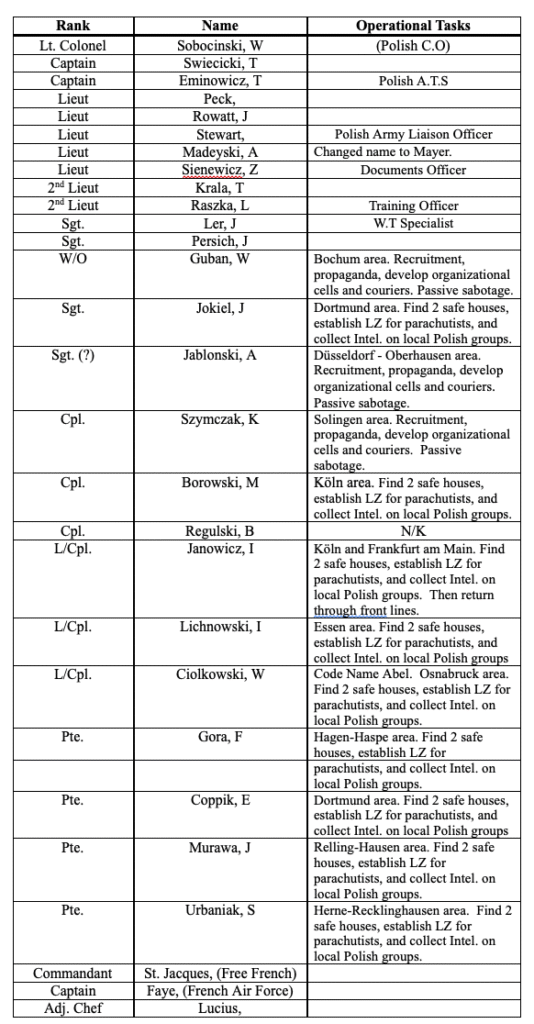
A table listing military ranks, names, and operational tasks, detailing responsibilities such as recruitment, sabotage, intelligence, and training for each individual.
Nominal Roll of Polish Personnel December 1944
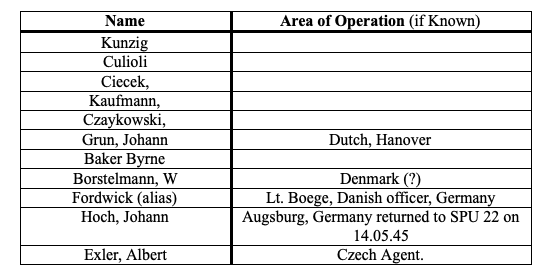
Table listing names alongside their areas of operation, including locations such as Dutch Hanover, Denmark, Germany, and Czechia, with some entries left blank or uncertain.
Nominal Roll of ‘Bonzos’

Attached to SPU 22 was a camouflage unit and workshop for use of the unit plus SPU. 47 (special reconnaissance unit), US 2nd Infantry Unit and I.S.9 an Anglo-American unit specialising in escaped Pows and downed airmen in conjunction with M.I.9 (TNA/ HS7-184).

Related Articles

  • Military map showing troop positions, movements, and river crossings near Wesel, Germany during Operation Varsity & Plunder on 24 March 1945.

    At War’s End

    61 mins
    Introduction The final days were a mixture of jubilation, exhaustion and terror of what was to come in most parts of Europe, the Balkans and Middle East.  Reynolds (2006) suggested that the ‘Big Three’ (Britain, the Soviet Union and the United States) wanted to maintain their wartime alliance on the basis for post-war international cooperation, even…
  • Memorial plaque honoring Polish Home Army paratroopers from England and Italy who died for Poland’s independence, with names listed on both sides and a central symbolic emblem.

    Cichociemni & The Role of Couriers

    131 mins
    Elite Polish WWII paratroopers, the Cichociemni, operated in secret to support the Home Army—trained in Britain, deployed by night, unseen couriers of freedom.
  • Black and white map showing V-2 rocket impact locations in Poland with arrows pointing from a test site near Mielec towards cities such as Warszawa, Radom, Lublin, and Kraków.

    The Underground War Against the V-1 and V-2s

    17 mins
    Introduction: The Nazi propaganda in the closing year of the Second World War, attempted to convince both German civilians and the High Command that the ‘wonder weapons’ (Wunderwaffen) would save the Reich. Research by the Nazi scientists into rockets and pilotless ‘flying bombs’ had been conducted in the 1930s. Rockets fell under the command of…
  • Map of the Baltic Sea in 1945 showing German evacuation routes, minefields, ship sinkings, front lines as of 31 Dec. 1944, and locations of Steuben, Gustloff, and Goya sinkings.

    S.A.A.R.F.

    114 mins
    An in-depth study of SAARF, M.E.42, and Operation VICARAGE—Allied missions rescuing POWs and tracing war criminals in 1945.
  • A city street with buildings in ruins and heavy smoke rising, likely due to a recent bombing or fire during wartime.

    The Warsaw Rising

    19 mins
    The 1944 Warsaw Rising saw Poland’s Home Army fight heroically for freedom as Soviet forces watched. Over 200,000 died and the city was left in ruins.
  • A detailed military map titled "Situation 2200 HRS 25 December 1944, Twelfth Army Group," showing troop positions, front lines, and geographical features in Europe.

    Operation DESFORD

    6 mins
    Operation Desford was a 1944 SOE mission planned in Hungary to link resistance forces, gather intelligence, and coordinate Allied sabotage against Germany.
  • Hand-drawn military map titled "Operation Viersen, Germany 18-24 Mar '45," showing troop movements, attacks, and defences near the Rhine River during WWII.

    Operation BARDSEA – Special

    7 mins
    Operation Bardsea (Special) saw Polish SOE forces unite Maquis resistance fighters in southern France in 1944 to disrupt German retreats after the Allied landings.
  • A typewritten letter dated 25 October 1943 discusses wartime experiences and observations, with handwritten notes and stamps visible at the top of the page.

    Operation DUNSTABLE

    13 mins
    Operation Dunstable was a secret WWII SOE–MI9 mission training Polish agents to aid POWs, sabotage German industry, and gather intelligence — later mired in postwar politics.
  • Typewritten military memo dated 25 May 1943, authorising Operation "Covey" to occur during the June Moon period, including use of one A-type parachute.

    Operation BARDSEA

    15 mins
    Operation Bardsea (1943–44) trained Polish Jedburgh-style paratroopers for sabotage and resistance behind enemy lines after D-Day, later linked to Operation Dunstable and Polish exile missions.
  • A map of Europe showing countries, major cities, and an area of brown dots concentrated across Poland, Germany, Czechoslovakia, Austria, Hungary, and surrounding regions.

    Operation MONIKA

    21 mins
    Operation Monika (1941–44) was an SOE-backed Polish underground network in France that organised sabotage, intelligence, and resistance among Polish émigrés, later supporting D-Day operations.
  • nan

    Continental Action

    56 mins
    A vast underground intelligence and resistance network spanning Europe, Scandinavia, and Latin America — gathering intelligence, aiding the Allies, and destabilising the Axis.
  • Black-and-white 1940s photo showing Polish intelligence officers planning around maps and radios in a wartime operations room.

    Polish Intelligence 1939-1945

    49 mins
    The story of Poland’s vast intelligence network (1939–45), from Enigma to the Home Army, and its crucial but often overlooked role in Allied victory.
  • Après le débarquement et la percée hors des têtes de pont en Normandie, le SOE (Special Operations Executive) a lancé des opérations de sabotage et de « propagande noire » ciblant des ressortissants polonais et d’autres nationalités détenus dans des camps de travail, en particulier là où l’Organisation Todt était active. Un réseau de maisons, situées dans le nord de la France et en Belgique, servait à diverses activités : formation, infiltration, examen de documents saisis en vue de créer de fausses identités, ou encore entraînement à l’assassinat, au sabotage et à la démolition.
    L’objectif de la mission était l’infiltration et l’exfiltration d’agents de différentes nationalités en Allemagne ; elle s’inscrivait dans un plan plus vaste élaboré par la sous-section des opérations de la division G-3 du SHAEF (quartier général suprême des forces expéditionnaires alliées). Trois objectifs principaux étaient visés :
    Évaluer les conditions de vie dans les camps de travail polonais.
    Établir des lignes de communication régulières.
    Organiser des cellules clandestines.
    Le 26 septembre 1944, le quartier général de la « SF Mission No. 22 » (Mission des forces spéciales n° 22) fut établi au château de Chevetogne, près de Rennes, afin de faciliter l’infiltration de petits groupes de forces spéciales ; cette unité travaillait également en coordination avec les équipes des opérations « Monica » et « Dunstable ». À mesure que l’invasion progressait rapidement vers l’intérieur des terres, il fut décidé de transférer la base au château La Fontaine, à Croix, près de Roubaix. Par ailleurs, l’opération disposait de sites satellites affectés à d’autres usages. Le bureau chargé des opérations spéciales polonaises était initialement situé à Verre, sur la route reliant Dinant à Marche — à environ huit kilomètres du quartier général du château de Chevetogne — et comptait six officiers ainsi que deux autres membres du personnel. Un centre de regroupement pour les agents fut mis en place au château Caument, à Wanlin ; on y dispensait des formations et l’on y finalisait les préparatifs d’infiltration, notamment en perfectionnant les techniques de survie en territoire ennemi. L’équipe se composait de sept officiers et de quatre militaires du rang. D’autres maisons de regroupement avaient été installées à proximité pour accueillir des agents d’autres nationalités.
    Le recrutement impliquait non seulement la « SF Mission No. 22 », mais aussi des officiers de l’unité de guerre psychologique de la Première armée américaine, rattachée au SHAEF. Des Polonais détenus dans des camps de travail en Belgique furent recrutés directement, ce qui permettait d’éviter l’implication du gouvernement polonais en exil. En matière de mobilisation, l’objectif était de recruter 12 500 hommes et de les envoyer au Royaume-Uni pour y suivre une formation. Le plan prévoyait également le recrutement d’au moins 3 000 hommes dans la région de Lille et dans le sud de la Belgique. Par ailleurs, dès octobre 1944, le lieutenant-colonel Stacy Lloyd, du 12e groupe d’armées américain, collabora avec l’unité de « propagande noire » de l’OSS pour recruter des « éléments étrangers » — notamment des Russes — en vue d’une « utilisation ultérieure » en Allemagne, après l’effondrement du régime nazi. L’état-major du SHAEF jugea ces opérations quelque peu « floues » ou « manquant de consistance », selon les termes employés dans une note interne.
    Les premiers agents (portant les noms de code Mark, Luke et John) furent infiltrés le 11 janvier 1945 à travers le front tenu par la 2e armée américaine. L’agent Luke regagna sa base le 20 avril 1945, après avoir mené sa mission à bien. Il retourna ensuite dans la zone opérationnelle, accompagné du commandant d’escadron Walters (officier de liaison de la RAF), afin de récupérer les agents Job, Abel et John dans la région de Cologne. Les premiers agents français rattachés à cette unité furent infiltrés le 9 février, en passant par le front situé entre les 1re et 3e armées américaines. Des commandos belges, également rattachés à cette unité, entrèrent en action le 5 avril ; toutefois, aucun détail supplémentaire n’est mentionné.

    L’unité était commandée par le colonel R. Hazell (MBE), assisté du capitaine Francis et du commandant Chalmers-Wright, qui constituaient le noyau des officiers. Les missions de l’unité n° 22 comprenaient également l’interrogatoire de prisonniers de guerre polonais ainsi que la collecte de documents nazis, destinés à des opérations clandestines et de renseignement. Le rassemblement de documents et d’autres matériels était indispensable pour fournir aux agents des pièces d’identité crédibles, nécessaires à leurs couvertures et à leurs pseudonymes. Ainsi, lors de la fouille d’une maison à Eupen, des documents vierges et des cachets officiels furent découverts ; des copies en furent par la suite envoyées au Royaume-Uni. Toutefois, la « guerre totale » entraînait des destructions matérielles considérables et des pénuries généralisées. En novembre 1945, le manque de vêtements adaptés pour les agents devint une source de préoccupation. À Geilenkirchen, des officiers, exposés à des tirs sporadiques, fouillèrent des habitations à la recherche de vêtements, de lunettes et d’autres objets — tels que des cartes de rationnement — afin de constituer les « garde-robes » nécessaires aux agents. Les pillages indiscriminés, commis par les troupes qui progressaient, donnèrent lieu à des plaintes auprès du quartier général du SHAEF, car des documents importants et d’autres biens précieux étaient soit détruits, soit dérobés. De même, lors de l’entrée de l’armée américaine à Aix-la-Chapelle (Aachen), les pillages et les destructions posèrent des problèmes majeurs à l’unité. Il fut alors suggéré d’intégrer les spécialistes en documents de l’unité aux troupes de première ligne, afin d’évaluer l’intérêt des matériels découverts et de limiter les dommages ou les pertes. La police militaire américaine, méfiante quant au rôle de cette unité, finit par délivrer des « laissez-passer bleus » spéciaux ; ceux-ci autorisaient une libre circulation à proximité du front et permettaient aux officiers du renseignement de récupérer divers équipements, uniformes et matériels, notamment des machines à écrire.

    Bien que le « journal de marche » de l’opération Euphemia consigne les événements opérationnels quotidiens et les déplacements du personnel, il met également en évidence des difficultés de communication liées aux opérateurs radio et aux systèmes de chiffrement. Le 9 mars 1945, Leo Marks (spécialiste du chiffrement) arriva sur place avec le lieutenant-colonel Parker pour discuter des problèmes de transmission avec le colonel Hazell. Cet épisode n’est toutefois pas mentionné dans ses mémoires, intitulés *Between Silk and Cyanide*.

    La progression rapide du front créait des risques pour les agents déployés sur le terrain, ces derniers se retrouvant parfois dépassés par l’avancée des lignes — une situation qui concernait notamment les agents infiltrés, surnommés les « Bonzos ». En avril 1945, l’unité comptait des agents infiltrés à Brême et dans la poche de la Ruhr ; elle avait également pris en charge des évadés de camps, tels que celui de Buchenwald. En avril 1945, le quartier général était situé à Eystrup, entre Hanovre et Brême ; avec la progression alliée en Allemagne, il fut transféré à Hambourg (Elbhöhe) début mai. Toutefois, la guerre touchant à sa fin, l’unité spéciale polonaise fut dissoute le 20 avril 1945.

    Ses activités comprenaient aussi le rapatriement d’agents du SOE ayant été capturés. Ainsi, le 7 mai 1945, les capitaines Mower-White et Wilde se rendirent à Lunebourg, au sud-est de Hambourg, pour récupérer la célèbre agente française Odette Sanson (épouse de Peter Churchill), qui fut ensuite ramenée par avion au Royaume-Uni. Odette faisait partie du réseau « Spindle » — qui connut un destin tragique — et fut arrêtée, avec Peter Churchill, par Hugo Bleicher ; elle subit des tortures avant d’être déportée au camp de Ravensbrück.

    Pour des raisons de sécurité, les antécédents de toutes les personnes figurant sur les listes d’effectifs firent l’objet de vérifications minutieuses. Dans la quasi-totalité des cas, ces agents étaient d’origine polonaise, avaient émigré en France avant la guerre et avaient été membres de la P.O.W.N. Il s’agissait, pour la plupart, de mineurs ou d’ouvriers agricoles ; beaucoup avaient travaillé temporairement en Allemagne, certains ayant même, par une ironie du sort, servi dans l’armée allemande durant la Première Guerre mondiale. Sur le plan de la sécurité et de la capacité à échapper à toute détection, il est intéressant de noter que leurs zones d’opération correspondaient à des lieux où ils avaient vécu par le passé et qu’ils connaissaient donc parfaitement. On peut supposer que, dans le chaos qui accompagna l’effondrement de l’empire nazi, cette stratégie visait à accroître leurs chances de survie et à faciliter le recrutement, plutôt qu’à les exposer au risque d’être reconnus.

    Le quartier général de la mission SF n° 22 supervisait également l’opération « Dunstable », notamment en ce qui concerne le financement et la logistique du personnel. Une note datée du 26 septembre 1944 (PRO HS4/239/223485) indiquait que le capitaine Federo devait être transféré de Paris à Lille afin de prendre en charge la conduite de l’opération « Dunstable », dotée d’un budget de 40 000 livres sterling. Le « journal de guerre » de l’opération Euphemia indique que la dernière journée opérationnelle fut le 27 mai 1945. En raison de l’absence de méthode uniforme dans l’enregistrement des agents, on estime que 18 agents polonais ont été infiltrés avec succès, aux côtés de 15 agents français spécialisés dans le sabotage et d’un nombre indéterminé de commandos belges. Leurs succès ou échecs ne sont pas consignés et, dans bien des cas, leur véritable identité demeure inconnue. Les listes nominatives suivantes ont été établies à partir de documents conservés au Public Record Office, à Kew (Londres) (TNA/ HS4-239-223485).

    (Veuillez lire la liste des noms)

    Rattachée à la SPU 22 se trouvait une unité de camouflage ainsi qu’un atelier, mis à la disposition de cette unité, de la SPU 47 (unité de reconnaissance spéciale), de la 2e division d’infanterie américaine et de l’I.S.9 — une unité anglo-américaine spécialisée dans la prise en charge des prisonniers de guerre évadés et des aviateurs abattus, en lien avec le M.I.9 (TNA/ HS7-184).

    Po lądowaniu w Normandii i przełamaniu przyczółków w Normandii, SOE rozpoczęło operacje sabotażowe i „czarnej propagandy” wymierzone w Polaków i inne narodowości przetrzymywane w obozach pracy, szczególnie tam, gdzie działała Organizacja TODT. Sieć domów zlokalizowanych w północnej Francji i Belgii była wykorzystywana do różnorodnych działań, od szkoleń i infiltracji, przez kontrolę przechwyconych dokumentów w celu fałszowania tożsamości, po proste szkolenia w zakresie zabójstw i wyburzeń.

    Celem misji była infiltracja/eksfiltracja wybranych agentów różnych narodowości do Niemiec i była ona częścią szerszego planu Podsekcji Operacyjnej Dywizji G-3 SHAEF. Trzy kluczowe cele obejmowały:
    Ustalenie warunków panujących w polskich obozach pracy.

    Ustanowienie stałych linii komunikacyjnych.

    Organizowanie komórek.

    26 września 1944 roku w Château de Chevetogne w pobliżu Rennes utworzono kwaterę główną misji sił specjalnych nr 22 (SF Mission No. 22), której zadaniem było przerzucanie niewielkich grup sił specjalnych; jednostka ta współpracowała również z zespołami realizującymi operacje „Monica” oraz „Dunstable”. W miarę szybkiego przesuwania się frontu inwazyjnego w głąb kraju podjęto decyzję o przeniesieniu bazy do Château La Fontaine w Croix, niedaleko Roubaix. Ponadto w ramach operacji wykorzystywano dodatkowe placówki („domy satelickie”) pełniące inne funkcje. Polska komórka operacji specjalnych mieściła się początkowo w Verre, przy drodze z Dinant do Marche – około pięciu mil od kwatery głównej w Château de Chevetogne – i liczyła sześciu oficerów oraz dwóch innych członków personelu. W Château Caument w Wanlin zorganizowano punkt przejściowy dla agentów, gdzie prowadzono szkolenia, dokonywano ostatecznych przygotowań do przerzutu oraz doskonalono umiejętności przetrwania na tyłach wroga. Zespół ten składał się z siedmiu oficerów i czterech żołnierzy innych stopni. W pobliżu utworzono również inne punkty przejściowe, w których przebywali przedstawiciele innych narodowości.

    W proces rekrutacji zaangażowana była nie tylko misja nr 22, ale także oficerowie jednostki ds. wojny psychologicznej (Psychological Warfare Unit) 1. Armii Stanów Zjednoczonych, przydzieleni do sztabu SHAEF. Polaków przebywających w obozach pracy w Belgii werbowano bezpośrednio, co pozwalało uniknąć angażowania polskiego rządu na uchodźstwie. Plan mobilizacyjny zakładał zwerbowanie 12 500 mężczyzn i wysłanie ich na szkolenie do Wielkiej Brytanii. Zakładano również pozyskanie co najmniej 3000 osób z okolic Lille oraz południowej Belgii. Ponadto podpułkownik Stacy Lloyd z 12. Grupy Armii USA współpracował z komórką „czarnej propagandy” amerykańskiego biura OSS, werbując już od października 1944 roku „elementy zagraniczne” – zwłaszcza Rosjan – z myślą o ich „przyszłym wykorzystaniu” na terenie Niemiec po upadku tego państwa. Sztabowcy w SHAEF oceniali te działania dość sceptycznie, określając je w jednej z notatek jako „niekonkretne” (ang. *wishy-washy*).

    Pierwsi agenci (o kryptonimach „Mark”, „Luke” i „John”) zostali przerzuceni za linię frontu 11 stycznia 1945 roku przez odcinek zajmowany przez amerykańską 2. Armię. Agent „Luke” powrócił do bazy 20 kwietnia 1945 roku, po pomyślnym zakończeniu swojej misji. W towarzystwie dowódcy eskadry (Squadron Leadera) Waltersa – oficera łącznikowego RAF – powrócił on w rejon działań operacyjnych, aby podjąć agentów o kryptonimach „Job”, „Abel” i „John” w okolicach Kolonii. Pierwsza grupa francuskich agentów przydzielonych do tej jednostki została przerzucona za linię frontu 9 lutego, w sektorze pomiędzy 1. a 3. Armią amerykańską. Belgijscy komandosi, również przydzieleni do tej jednostki, rozpoczęli działania 5 kwietnia – brak jednak szczegółowych informacji na temat przebiegu tych operacji.

    Jednostką dowodził pułkownik R. Hazell (odznaczony orderem MBE), a trzon kadry oficerskiej stanowili kapitan Francis oraz major Chalmers-Wright. Do zadań jednostki nr 22 należało również przesłuchiwanie polskich jeńców wojennych oraz gromadzenie dokumentów nazistowskich na potrzeby działań wywiadowczych i tajnych operacji. Pozyskiwanie dokumentów i innych materiałów było kluczowe dla tworzenia wiarygodnych „legend” (fałszywych tożsamości) dla agentów. Przykładowo, podczas przeszukiwania domu w Eupen odnaleziono wartościowe czyste druki urzędowe oraz pieczęcie; ich kopie przesłano następnie do Wielkiej Brytanii. Wojna totalna wiązała się jednak z ogromnymi zniszczeniami mienia i dotkliwymi brakami niemal wszystkich dóbr. W listopadzie 1945 roku poważnym problemem stał się brak odpowiedniej odzieży dla agentów. W Geilenkirchen oficerowie – często pod ostrzałem – przeszukiwali domy w poszukiwaniu ubrań, okularów czy drobnych przedmiotów, takich jak kartki żywnościowe, aby skompletować „garderobę” dla swoich agentów. Masowe i bezkrytyczne grabieże dokonywane przez nacierające oddziały stały się powodem skarg kierowanych do dowództwa SHAEF, gdyż dochodziło do niszczenia lub kradzieży istotnych dokumentów i innych cennych materiałów. Podobne problemy pojawiły się w Akwizgranie (Aachen), gdzie plądrowanie i zniszczenia utrudniały pracę jednostki. Zasugerowano wówczas, aby specjaliści jednostki ds. dokumentacji towarzyszyli oddziałom na pierwszej linii frontu – miało to pozwolić na ocenę wartości przejmowanych materiałów oraz ograniczenie strat i zniszczeń. Amerykańska żandarmeria wojskowa (Military Police) podchodziła do roli jednostki z podejrzliwością; w rezultacie wydano specjalne „niebieskie przepustki”, które umożliwiały swobodne poruszanie się w pobliżu linii frontu i pozwalały oficerom wywiadu na zabezpieczanie różnorodnego sprzętu, mundurów oraz przedmiotów, takich jak maszyny do pisania.

    Choć „dziennik działań” (War Diary) operacji „Euphemia” szczegółowo odnotowuje codzienne wydarzenia operacyjne i przemieszczenia personelu, wskazuje również na trudności w komunikacji, wynikające z problemów z operatorami radiowymi oraz szyframi. Leo Marks (specjalista ds. szyfrów) przybył 9 marca 1945 roku wraz z podpułkownikiem Parkerem, aby omówić kwestie łączności z pułkownikiem Hazellem. W swoich wspomnieniach, zatytułowanych „Between Silk and Cyanide”, Marks nie odnotował tego wydarzenia.

    Szybko przesuwająca się linia frontu zaczęła stanowić zagrożenie dla agentów działających w terenie, gdyż front zaczął wyprzedzać przenikniętych w głąb przeciwnika operatywników, nazywanych „Bonzos”. Do kwietnia 1945 roku jednostka posiadała agentów w Bremie oraz w Zagłębiu Ruhry; zajmowała się również osobami zbiegłymi z obozów, takich jak Buchenwald. W kwietniu 1945 roku dowództwo mieściło się w Eystrup, pomiędzy Hanowerem a Bremą, a w związku z postępami wojsk alianckich w głębi Niemiec, na początku maja przeniesiono je do Hamburga (dzielnica Elbhöhe). Wojna zbliżała się jednak ku końcowi i 20 kwietnia 1945 roku Polska Jednostka Specjalna (Polish Special Unit) została rozwiązana.

    Do zadań jednostki należała również repatriacja operatywników SOE, którzy wcześniej dostali się do niewoli – przykładem może być sytuacja z 7 maja 1945 roku.

    (Proszę przeczytać listę imion)

    Do jednostki SPU 22 przydzielono pododdział zajmujący się maskowaniem oraz warsztat, z których korzystała zarówno ta jednostka, jak i SPU 47 (oddział specjalnego rozpoznania), 2. Dywizja Piechoty USA oraz I.S.9 – jednostka anglo-amerykańska, która we współpracy z M.I.9 zajmowała się zbiegłymi jeńcami wojennymi i lotnikami, których samoloty zostały zestrzelone (TNA/ HS7-184).

    A rectangular cloth banner with the text "FRONT NATIONAL F.T.P.F. F.F.L." in bold black letters on a light background.

    Polish Batallions

    Polish resistance fighters in France joined the M.O.I and F.T.P.F, sabotaging German forces and aiding liberation efforts alongside the French Maquis.

    Read Article
    Black and white portrait of a man in a military uniform and cap, facing slightly to the side.

    Mieczyslaw M. Wnuk

    From Olympic skier to wartime escapee and commando trainer — the epic journey of Polish officer Mieczyslaw Wnuk from Zakopane to Dunblane, Scotland.

    Read Article
    Anthony Tucker-Jones (2008),

    Falaise. The Flawed Victory: The destruction of Panzergruppe West, August 1944

    A critical book review analysing Tucker-Jones's "Falaise", assessing Allied strategy, German defence and Polish battlefield contributions.

    Read Article