Opens in a new tab

Blackpool 1940

  • Table of Contents

Blackpool, Lancashire
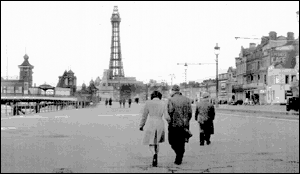
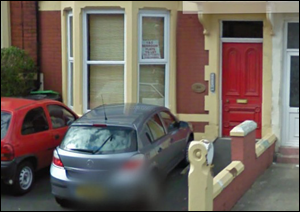
Goodwood Hotel, 209 Hormby Road. Kindly donated by Martin Feledziak

The sea-side town of Blackpool became the playground for the industrial north during the Victorian Era. The Industrial Revolution and the ‘Age of Steam’ brought prosperity through improvements to working conditions and increased leisure time. The wealth of the town was reflected in the grandeur of the lavish architectural design applied to the hotels on the Golden Mile and in quieter side streets leading away from the seafront. The town had enjoyed its prime position as a holiday resort right up until the outbreak of war in 1939.
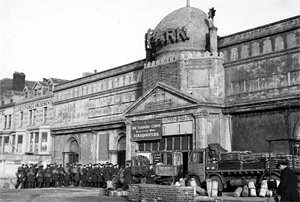
Black and white photo of people and lorries outside a large, weathered building labelled "BATHS," serving as a training corps headquarters.

War brought a new role to the town. After Dunkirk, Blackpool became the depot for Polish aircrew prior to being despatched to stations or depots for training or operations. New arrivals were sent to the Goodwood Hotel in Hornby Road for debriefing and registration prior to unit assignment and despatch. (The Lansdowne Hotel became the Polish Airforce HQ). In the aftermath of Dunkirk forces were left short of equipment and in a pretty poor shape. Britain was on invasion alert. For the young Poles, duties were regarded as tedious and quite demeaning. Young men had lied over their ages to enlist and fight. Construction of prisoner of war camps was often the closest action many saw in the early months of their war. While the Goodwood Hotel became a centre for enlistment, the White Eagle Club also in Hornby Road,became the officers club.
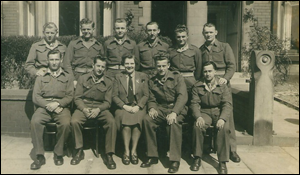
A group of ten men in military uniforms and one woman in civilian clothing sit and stand in two rows outdoors in front of a building.
Goodwood Hotel, 209 Hormby Road. Kindly donated by Martin Feledziak
A grey car is parked in a small drive in front of a house with a red door; a red car is parked on the street beside it.
La traduction française de cet article n'est pas encore disponible.
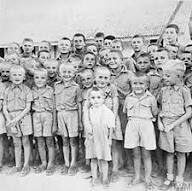
A group of boys in uniform pose for a photo outdoors, with one smaller child standing at the front.

Polish Deportees and Refugees in Foreign Lands

Displaced Poles from the outbreak of the Second World War and the partitioning of Poland between Nazi Germany and the Soviet Union, remains one of the extraordinary stories that is both captivating and assuring humanity existed during one of the darkest times in Europe. With the fall of France in June 1940, the Polish Army…

Read Article
A partially dismantled vintage rifle with a wooden stock and metal parts laid out on a wooden surface.

The Technical and Non-Technical Services for the PAF

Introduction: One area overlooked by historians is the role of research and development (R&D) by the PAF (Polish Air Force) during World War II.  For some, the subject lacks the ‘draw’ of operations and yet it is a vital role within both the army, navy and the air force.  The need for R&D was not well understood…

Read Article
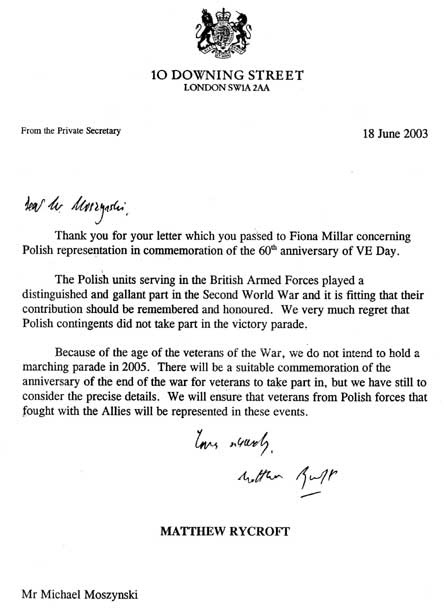
A formal letter from 10 Downing Street dated 18 June 2003 discussing Polish representation in VE Day commemorations, signed by Matthew Rycroft.

Letter from 10 Downing Street (18/06/03)

A 2003 letter from 10 Downing Street expresses regret for Poland’s exclusion from the 1946 Victory Parade and pledges recognition in future commemorations.

Read Article