Opens in a new tab

Operation BARRIER (Bariera)

  • Table of Contents

The AK had a number of diversionary operations against the Germans throughout the war. These were:

Wachlarz (See https://polandinexile.com/article/operation-wachlarz-fan/

Wieniec (See https://polandinexile.com/article/operation-wieniec-garland/)

Jula and Ewa (See https://polandinexile.com/article/operation-jula-and-ewa-april-1944/)

Burza (See https://polandinexile.com/article/the-warsaw-rising/)

There was a constant campaign from 1941 until 1945 to disrupt rail communications which resulted in 1,175 operations which destroyed and derailed 19,058 rail cars, 1,165 fuel tank cars, 38 bridges and 4,326 military vehicles. Prisons were attacked are inmates freed and over 2,000 Gestapo informers assassinated (Bałuk, 1995). The Cichociemni were dropped into Poland to support these operations and the Kedyw (Directorate of Sabotage).

The map below shows the location of the operations.

Operation BARRIER
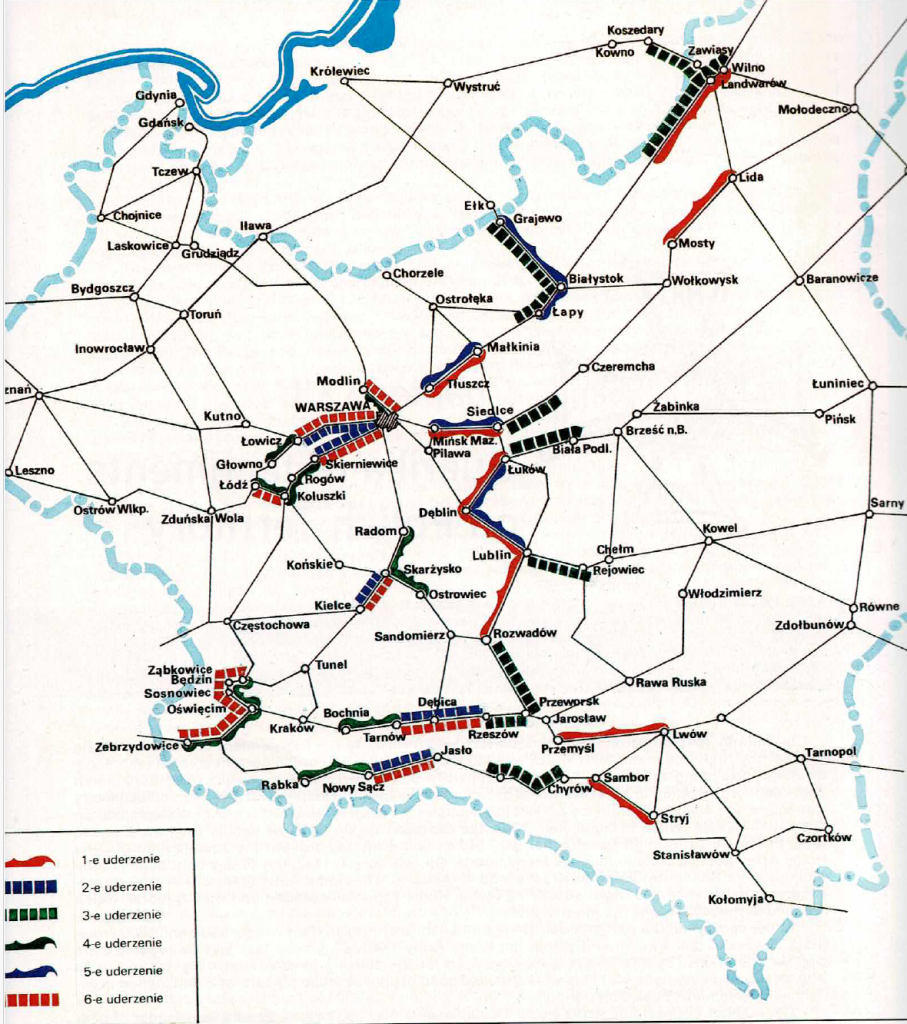
A map of Poland showing major cities, railways, and six colour-coded military strike directions with corresponding legends at the bottom left.

Source: Bałuk (1995)

Organisation and Employment:

Typically a partisan unit had a Battle Unit consisting of 75-100 men in 2-3 Companies. Diversion Sections Sections who were tasked with sabotage of rail, road and telecommunications consisted of 3-10 men and led by a unit commander who issued the orders (TNA/ HS4-143). The AK operated on similar lines.
La traduction française de cet article n'est pas encore disponible.

W trakcie wojny Armia Krajowa (AK) przeprowadziła szereg operacji dywersyjnych wymierzonych w Niemców. Były to m.in.:
Wachlarz (zob. https://polandinexile.com/article/operation-wachlarz-fan/)
Wieniec (zob. https://polandinexile.com/article/operation-wieniec-garland/)
Jula i Ewa (zob. https://polandinexile.com/article/operation-jula-and-ewa-april-1944/)
Burza (zob. https://polandinexile.com/article/the-warsaw-rising/)

W latach 1941–1945 prowadzono ciągłe działania mające na celu zakłócenie komunikacji kolejowej; w ich wyniku przeprowadzono 1175 akcji, podczas których zniszczono lub wykolejono 19 058 wagonów kolejowych i 1165 cystern z paliwem, a także zniszczono 38 mostów i 4326 pojazdów wojskowych. Atakowano więzienia, uwalniając osadzonych, oraz zlikwidowano ponad 2000 konfidentów Gestapo (Bałuk, 1995). Do Polski zrzucano „Cichociemnych”, aby wspierali te operacje oraz działania Kedywu (Kierownictwa Dywersji).
Poniższa mapa przedstawia lokalizację tych operacji.

Mapa Polski ukazująca główne miasta, linie kolejowe oraz sześć oznaczonych kolorami kierunków uderzeń wojskowych, wraz z odpowiednimi legendami w lewym dolnym rogu.
Źródło: Bałuk (1995)
Organizacja i sposób działania:
Typowy oddział partyzancki składał się z pododdziału bojowego liczącego 75–100 ludzi, podzielonego na 2–3 kompanie. Sekcje dywersyjne, których zadaniem było prowadzenie sabotażu infrastruktury kolejowej, drogowej i telekomunikacyjnej, liczyły od 3 do 10 osób i były dowodzone przez dowódcę wydającego rozkazy (TNA/ HS4-143). Armia Krajowa działała na podobnych zasadach.

Parachuting into Poland, 1944: A memoir of a Secret Mission with Józef Retinger.

Parachuting into Poland, 1944: A memoir of a Secret Mission with Józef Retinger.

Marek Celt’s memoir offers a vivid, first-hand account of Operation Salamander, detailing Józef Retinger’s secret 1944 mission to Poland and the political intrigue, danger, and courage behind it.

Read Article
Black and white photo of a man in a military uniform, wearing a medal and looking slightly to the side.

Bacia, Stanislaw, Adam (1914 – 1969)

The remarkable story of Captain Stanisław Bacia, from his early life and military training in Poland, through the 1939 campaign, escape to France, and internment in Switzerland, to his post-war life in Scotland and Australia as a respected leader in the Polish community.

Read Article
Four soldiers in winter uniforms operate and observe a vintage radio communication device in a snowy forest.

Operation FLAMSTEAD and FERNHAM

Operations Flamstead and Fernham aimed to link with Polish POWs and forced labourers in 1944, but Soviet advances and Germany’s collapse ended the missions.

Read Article