Opens in a new tab

Operation BARRIER (Bariera)

  • Table of Contents

The AK had a number of diversionary operations against the Germans throughout the war. These were:

Wachlarz (See https://polandinexile.com/article/operation-wachlarz-fan/

Wieniec (See https://polandinexile.com/article/operation-wieniec-garland/)

Jula and Ewa (See https://polandinexile.com/article/operation-jula-and-ewa-april-1944/)

Burza (See https://polandinexile.com/article/the-warsaw-rising/)

There was a constant campaign from 1941 until 1945 to disrupt rail communications which resulted in 1,175 operations which destroyed and derailed 19,058 rail cars, 1,165 fuel tank cars, 38 bridges and 4,326 military vehicles. Prisons were attacked are inmates freed and over 2,000 Gestapo informers assassinated (Bałuk, 1995). The Cichociemni were dropped into Poland to support these operations and the Kedyw (Directorate of Sabotage).

The map below shows the location of the operations.

Operation BARRIER
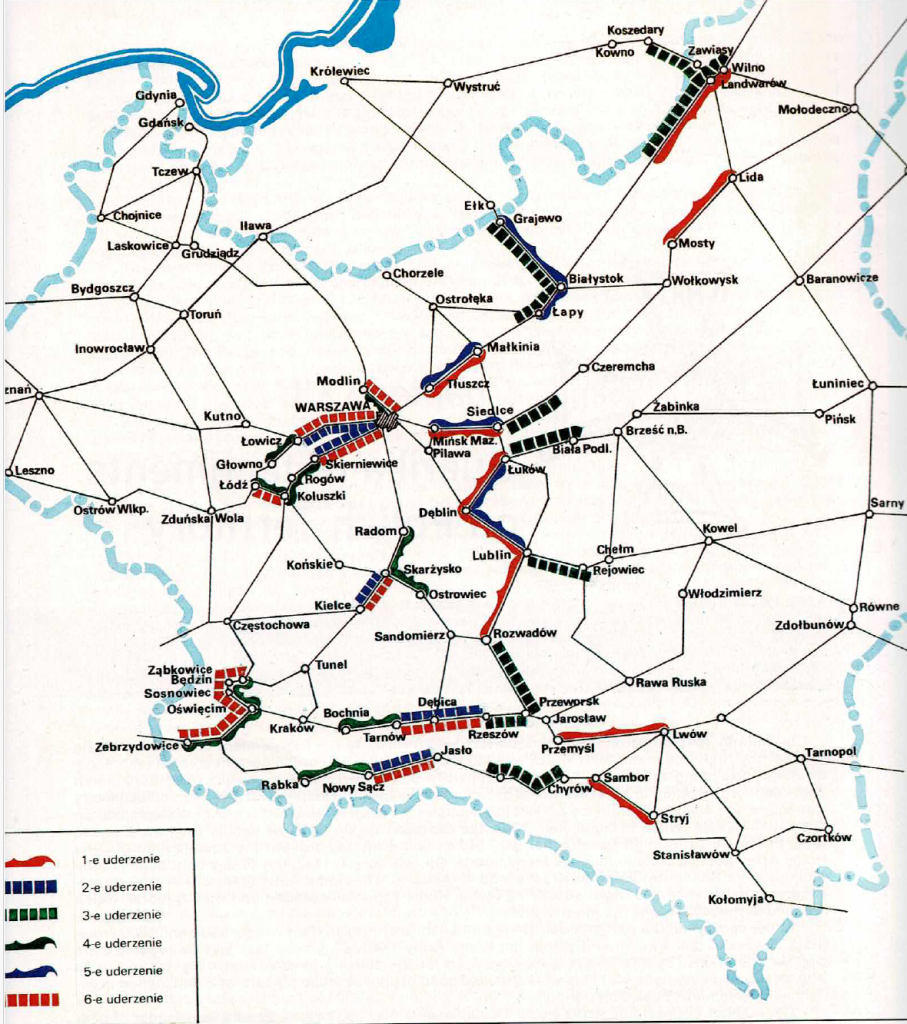
A map of Poland showing major cities, railways, and six colour-coded military strike directions with corresponding legends at the bottom left.

Source: Bałuk (1995)

Organisation and Employment:

Typically a partisan unit had a Battle Unit consisting of 75-100 men in 2-3 Companies. Diversion Sections Sections who were tasked with sabotage of rail, road and telecommunications consisted of 3-10 men and led by a unit commander who issued the orders (TNA/ HS4-143). The AK operated on similar lines.

La traduction française de cet article n'est pas encore disponible.

W trakcie wojny Armia Krajowa (AK) przeprowadziła szereg operacji dywersyjnych wymierzonych w Niemców. Były to m.in.:
Wachlarz (zob. https://polandinexile.com/article/operation-wachlarz-fan/)
Wieniec (zob. https://polandinexile.com/article/operation-wieniec-garland/)
Jula i Ewa (zob. https://polandinexile.com/article/operation-jula-and-ewa-april-1944/)
Burza (zob. https://polandinexile.com/article/the-warsaw-rising/)

W latach 1941–1945 prowadzono ciągłe działania mające na celu zakłócenie komunikacji kolejowej; w ich wyniku przeprowadzono 1175 akcji, podczas których zniszczono lub wykolejono 19 058 wagonów kolejowych i 1165 cystern z paliwem, a także zniszczono 38 mostów i 4326 pojazdów wojskowych. Atakowano więzienia, uwalniając osadzonych, oraz zlikwidowano ponad 2000 konfidentów Gestapo (Bałuk, 1995). Do Polski zrzucano „Cichociemnych”, aby wspierali te operacje oraz działania Kedywu (Kierownictwa Dywersji).
Poniższa mapa przedstawia lokalizację tych operacji.

Mapa Polski ukazująca główne miasta, linie kolejowe oraz sześć oznaczonych kolorami kierunków uderzeń wojskowych, wraz z odpowiednimi legendami w lewym dolnym rogu.
Źródło: Bałuk (1995)
Organizacja i sposób działania:
Typowy oddział partyzancki składał się z pododdziału bojowego liczącego 75–100 ludzi, podzielonego na 2–3 kompanie. Sekcje dywersyjne, których zadaniem było prowadzenie sabotażu infrastruktury kolejowej, drogowej i telekomunikacyjnej, liczyły od 3 do 10 osób i były dowodzone przez dowódcę wydającego rozkazy (TNA/ HS4-143). Armia Krajowa działała na podobnych zasadach.

Kozłowski, By Jane Rogoyska

Kozłowski

A moving account of a Polish survivor of the Katyn Massacre, exploring loss, exile, and post-war trauma through meticulously researched historical fiction.

Read Article
Two men in flying suits and life vests stand beside a military aeroplane, with one holding a piece of equipment and both appear to be engaged in conversation.

Zenon Stefan Teofil Bartkowiak

Zenon Stefan Teofil Bartkowiak—Polish airman who escaped occupied Europe to serve with the RAF, embodying courage, endurance, and the indomitable Polish spirit.

Read Article
Black and white photo showing several warships docked in a harbour with smoke or haze in the background. The image appears historical and industrial.

Norwegian Campaign

The 1940 Norwegian Campaign saw Allied and Polish forces fight fierce naval and mountain battles at Narvik, delaying German expansion but ending in costly evacuation.

Read Article