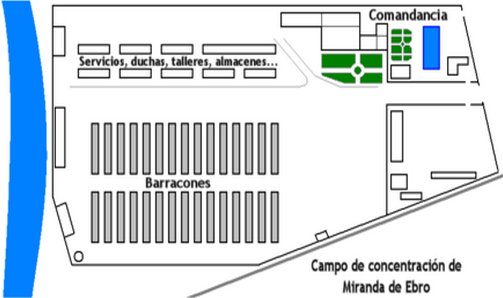
Miranda de Ebro in the Burgos region was a ‘notorious’ concentration camp set up by the Franco regime (Servicio de Colonias Penitenciarias Militarizadas), modelled on Nazi ideology and was functioning between 1940 until 1947. Located about 1Km from the railway station, little of the camp remains today, however it was designed to hold only 1,700 prisoners. Initially it housed Republican prisoners from the Spanish Civil War, particularly from the International Brigade. After the fall of France in 1940 the concentration camp had French, Belgian, British, Poles (the largest foreign contingent) and a separate group for Jews. It is also reported a separate camp Campo Aleman housed German collaborators and former military personnel who were repatriated to Germany after a visit by Himmler in 1940. In total some 15,412 prisoners were housed in the camp and the inmates were required to work in a backbreaking quarry. The average number of inmates was around 3,500.
La (2008) identified 18,000 French escaped forced labour in Germany by fleeing to Spain by the end of 1943 where the survival rates despite poor hygiene was higher than those who escaped over the Pyrenees. The general conditions including lack of clean water, meant the internees suffered from outbreaks of yellow fever, scabies and dysentery and during the winter severe cold. Personal accounts like Władysław Popiołek understate the conditions, however, it does indicate that despite all, camaraderie flourished and the desire to be free to fight particularly motivated the Polish contingent.
For those crossing the Pyrenees through the escape lines, the guides warned of the risks being caught by the civil guard (Guardia Civil). To overcome arrest the escape lines provided small amounts of money for food, transport and bribes. Philip Newman’s (1983) account of crossing the Pyrenees through the Pat Line outlines the hardships and also the intricate detail of how the escape lines assisted them. In John Dunbar’s (1955) account Escape through the Pyrenees there was much local support in northern Spain despite the ever-present threat of arrest. While imprisoned in Pamplona he learnt of the shootings and torture of Republican sympathisers and for the foreigners, while all dreamed of release, those who were of special interest to the Gestapo would find them waiting outside for those who managed to be released. Some escapees having endured the hardship of crossing the Pyrenees, found their journey although fraught with danger, was a mixture of tension, varying degrees of comfort or the conditions of transport or boredom and at times bizarre encounters. In Mieczyslaw Wnuk’s (2006) account the degree of logistics and organization through the Polish Consulate mirrored the organised escape lines like the Pat Line or Comète Line and all had the same goal – get the men ‘home’ safely.
After the invasion of Europe in 1944 the profile of inmates slowly altered with increasing number of German and Italian deserters being housed and by 1945 a number of former Nazi’s were interned in the camp.
References
Dunbar, J. (1955) “Escape through the Pyrenees”, W.W. Norton & Co. Inc, USA
Eiroa, M (2005) “Refugiados extranjeros en España: el campo de concentración de Miranda de Ebro”, Ayer Vol. 57 No.1 pp.125-152.
González-Ruibal, A. (2011) “The Archaeology of Internment in Francoist Spain (1936-1952)” in Adrian Myers and Gabriel Moshenska (eds.): The Archaeology of Internment , Springer, USA, pp. 53-74.
La, H (2008) “Miranda de Ebro: Medical condition of the concentration camp in the autumn of 1943”, Journal of Historic Science and Medicine, No.42, Vol.2, pp. 205-214.
Newman, P (1983) Over the wire: A P.O.W’s escape story from the second world war”, re-printed by Pen & Sword Military (2013), UK
Shuff, D. (2003) “Evader”,Spellmount, UK. Wnuk, M (2006) From Poland to England:One man’s WWII Journey”, privately published by Scriptum, Poland/ USA.
Wysocki, B. A (1988) “Urge to live”, Magnificat Press, USA
Useful online References:
http://www.conscript-heroes.com/
http://tablet.archive.netcopy.co.uk/article/8th-may-1943/8/twenty-six-months-in-miranda-de-ebro http://halifax346et347.canalblog.com/archives/les__evades_de_miranda/index.html www.effelle.fr/francais-libre/evades-de-france/